


Can You Track an Employee’s Vehicle Legally?


GPS tracking is widely used by Australian businesses to manage fleets, improve efficiency, and protect assets. But one of the most common questions employers ask is:
Can you legally track an employee’s vehicle?
The short answer is: Yes, you can — if the vehicle is company-owned and tracking is disclosed and used lawfully.
However, there are important rules around consent, privacy, and workplace surveillance that must be followed.
This article explains what is legal, what is not, and how employers can use GPS tracking correctly.
Tracking Company Vehicles Used by Employees
If the vehicle is owned or leased by the business, employers are generally permitted to install GPS tracking.
This is legal when:
- The tracking is for legitimate business purposes
- Employees are informed that tracking is in place
- The business complies with workplace surveillance and privacy laws
Legitimate business purposes include:
- Job dispatch and scheduling
- Fleet management
- Theft prevention and recovery
- Driver safety
- Compliance and reporting
- Fuel and route optimisation
The Importance of Disclosure
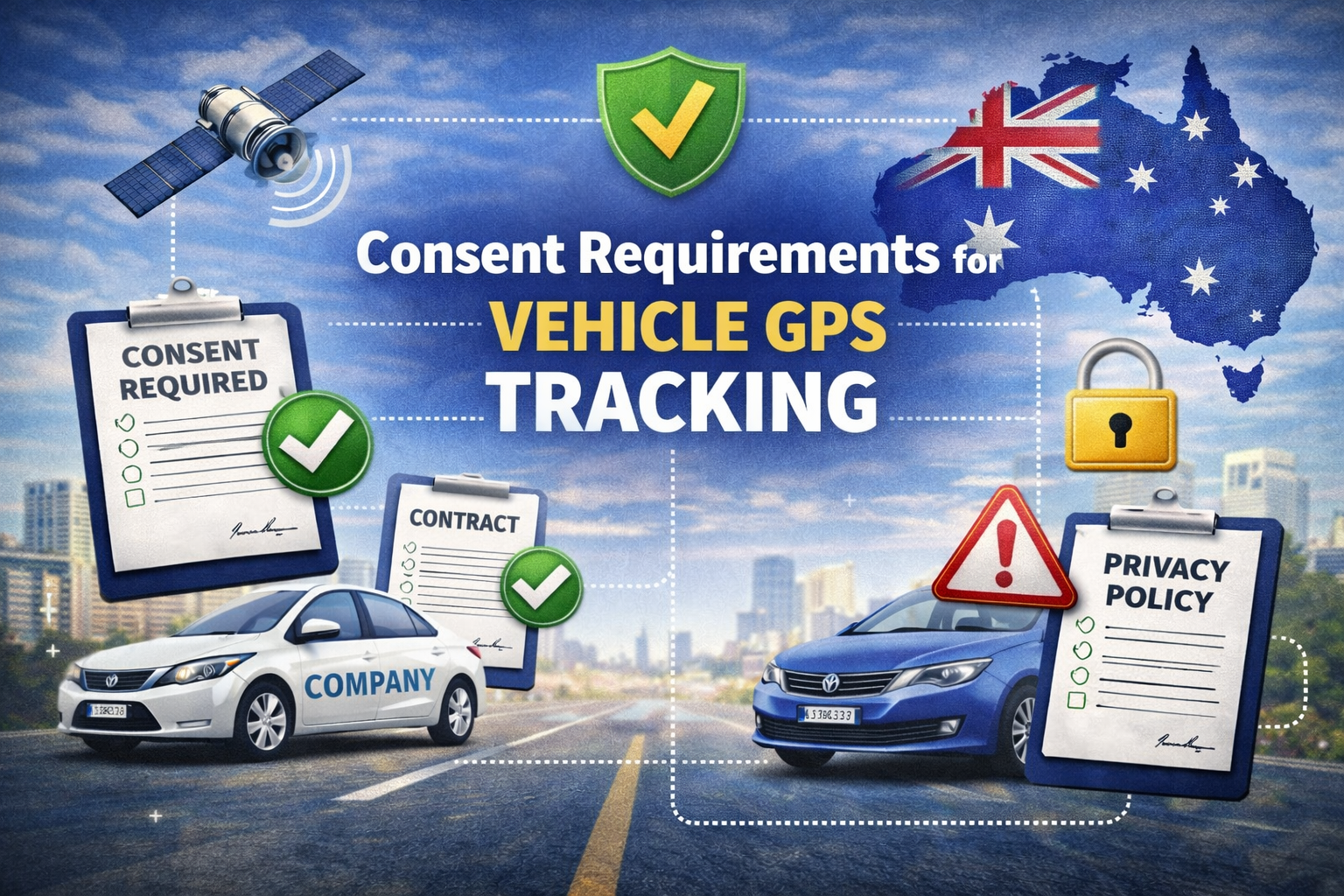
One of the most important legal requirements is disclosure.
Employees must be told that GPS tracking is in place. This is typically done through:
- Employment contracts
- Workplace policies
- Fleet policies
- Onboarding documents
- Written notices
Secretly tracking employees without their knowledge can be unlawful and expose the business to serious legal risk.
Workplace Surveillance Laws in Australia
Australia does not have one single national workplace surveillance law. Each state has its own legislation, such as:
- New South Wales – Workplace Surveillance Act
- Victoria – Surveillance Devices Act
- Queensland – Invasion of Privacy Act
- Western Australia, South Australia, ACT, NT – Various surveillance and privacy laws
While the specifics vary, the principles are similar across Australia:
- Surveillance must be for legitimate purposes
- Employees must be informed
- Covert surveillance is heavily restricted
If your business operates across multiple states, it is safest to follow the strictest standard.
Tracking Personal Vehicles Is Different
There is a critical legal distinction between company vehicles and personal vehicles.
Company Vehicles
Employers can track vehicles they own or control, provided:
- Employees are informed
- Tracking is lawful and proportionate
- Policies are in place
Personal Vehicles
Installing a GPS tracker on an employee’s personal vehicle without consent is generally not legal.
You should never track:
- An employee’s personal car
- A contractor’s personal vehicle
- Any vehicle you do not own or have authority over
Without clear consent, this can be unlawful.
Tracking Outside Work Hours
This is an important and often misunderstood area.
If a company vehicle is used after hours, employers should:
- Clearly define working hours
- Have policies explaining how after-hours data is handled
- Avoid unnecessary monitoring outside business use
Best practice is to:
- Use tracking data only for business purposes
- Limit access to authorised staff
- Avoid intrusive or excessive monitoring
Overly intrusive tracking can create legal and employee relations issues.
GPS Tracking and Privacy Obligations
Because GPS tracking can identify a person’s movements, it involves personal information.
Employers must:
- Use tracking data only for legitimate business reasons
- Restrict access to authorised personnel
- Store data securely
- Avoid misuse or unnecessary monitoring
Tracking should be proportionate and reasonable.
Using GPS Data for Performance Management
Many businesses use GPS data to:
- Review routes and job times
- Investigate customer complaints
- Improve efficiency and productivity
This is generally lawful if:
- Employees are informed
- Policies explain how data may be used
- Tracking is not used unfairly or punitively
GPS tracking should support performance, not be used as a disciplinary weapon.
GPS Tracking for Safety
GPS tracking is commonly used for:
- Lone worker safety
- Emergency response
- Incident investigation
- Fatigue management
These are legitimate and often encouraged uses, especially in:
- Trades and services
- Transport and logistics
- Mining and remote work
- Utilities and infrastructure
Can You Use a Kill Switch on an Employee Vehicle?
Some GPS trackers support engine immobilisation (kill switch) features.
For employer use:
- The vehicle must be company-owned
- The system must be professionally installed
- The feature must only be used when the vehicle is safely stationary
- It must be used lawfully and responsibly
Kill switches should be used for security purposes, not as a disciplinary tool.
What Employers Should Never Do
Employers should never:
- Track employees secretly
- Track personal vehicles without consent
- Use GPS data to harass, intimidate, or stalk
- Use tracking for non-work purposes
- Misuse location data
These actions can expose the business to serious legal and reputational risk.
Who Is Responsible for Compliance?
The responsibility sits with the employer or business owner.
GPS providers supply the technology, but:
- Employers must ensure lawful use
- Employers must obtain any required consent
- Employers must comply with workplace and privacy laws
This is standard across Australia.
Best Practice for Employers
To stay compliant and protect your business:
- Inform employees clearly
- Have a written GPS tracking policy
- Use tracking for legitimate business purposes only
- Limit access to tracking data
- Handle data securely
- Train managers on appropriate use
This protects both the business and employees.
Final Thoughts
Yes, employers can legally track employee vehicles in Australia — when the vehicle is company-owned and tracking is disclosed and used responsibly.
The key is:
- Transparency
- Consent
- Legitimate purpose
- Proportionate use
When these principles are followed, GPS tracking is a powerful and lawful tool for managing fleets and improving business performance.

Continue researching
Useful EZY GPS product and setup resources
Compare tracker types, review plan pricing and follow practical installation guidance after reading an EZY GPS article.